

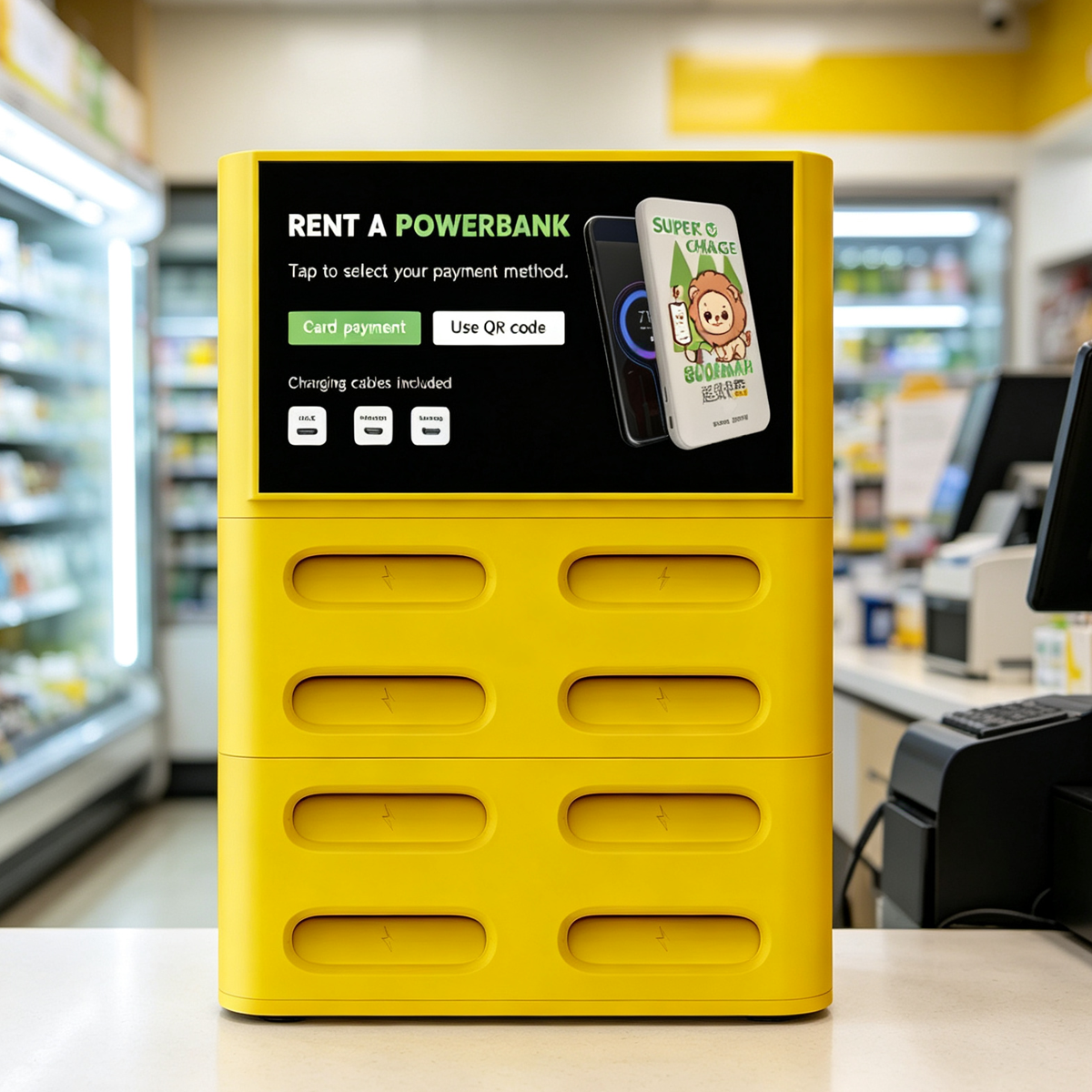
Shared Power Bank Station Buying Guide: 8-Slot vs 12-Slot vs 24-Slot vs 40-Slot
Choosing the right power bank rental station is one of the first decisions operators need to make when launching a shared power bank rental station business.
Should a café use an 8-slot station? Is a 12-slot model enough for a busy restaurant? When should you choose a 24-slot or 40-slot power bank rental station?
The answer is not simply “the bigger, the better.”
A successful deployment should match station capacity with customer traffic, expected rental frequency, venue type, available space, advertising requirements and operating budget.
For most overseas operators, especially those entering a new market, selecting the right station for each location is often more important than purchasing the largest available model.
This guide compares 8-slot, 12-slot, 24-slot and 40-slot shared power bank stations and explains how to choose the right configuration for different business scenarios.
1. The Biggest Shared Power Bank Rental Station Is Not Always the Best Choice
One of the most common mistakes new operators make is using the same station model for every location.
A small café and a busy airport have completely different rental demand.
Installing a 40-slot station in a small restaurant may unnecessarily increase hardware investment, while placing an 8-slot station in a high-traffic transportation hub may result in insufficient power bank availability during peak periods.
The better strategy is:
Match the station capacity to the actual traffic and rental potential of each venue.
This allows operators to control initial investment while keeping enough available power banks to meet customer demand.
For overseas markets, operators also do not necessarily need to deploy large numbers of machines immediately. A more practical approach is to select good locations, operate them carefully and expand after real rental data confirms demand.
2. 8-Slot vs 12-Slot vs 24-Slot vs 40-Slot: Quick Comparison
Station Size Recommended Locations Traffic Level Main Advantage
8-Slot Cafés, small restaurants, retail stores, salons Low to Medium Low investment and easy deployment
12-Slot Restaurants, bars, hotels, gyms Medium Good balance of capacity and cost
24-Slot Shopping malls, busy entertainment venues, tourist attractions Medium to High More availability during busy periods
40-Slot Airports, transport hubs, stadiums, major malls, events High Large capacity for heavy rental demand
There is no universal configuration that works for every business.
A good rental network may use several station sizes at the same time.
For example, an operator may place 8-slot stations in cafés, 12-slot stations in restaurants and bars, and larger 24-slot or 40-slot stations in shopping malls or transportation hubs.
3. When Should You Choose an 8-Slot Power Bank Station?
An 8-slot power bank station is one of the most practical options for small and medium-sized venues.
It is particularly suitable for:
Cafés
Restaurants
Convenience stores
Beauty salons
Small hotels
Retail stores
Small waiting areas
The main advantage is lower initial hardware investment.
If a location does not have many customers renting power banks at the same time, there is little reason to install a very large station.
This makes an 8-slot station particularly useful when testing a new market.
Instead of investing heavily before understanding local demand, operators can deploy compact stations across several carefully selected locations and monitor actual rental frequency.
Once a location consistently reaches high utilization, the operator can replace or supplement the station with a larger model.
Best For:
Low-risk pilot projects and distributed local networks.
4. When Is a 12-Slot Power Bank Station Better?
A 12-slot power bank station provides additional capacity without requiring the size and investment of a large kiosk.
It works well for locations such as:
Busy restaurants
Bars
Hotels
Gyms
Entertainment venues
Medium-sized retail stores
Tourist businesses
Compared with an 8-slot station, the additional slots provide more flexibility during peak periods.
For example, a restaurant may have relatively low charging demand during the afternoon but significantly more customers during dinner hours.
A 12-slot configuration creates additional buffer capacity without dramatically increasing the size of the equipment.
For many operators, this makes the 12-slot station a balanced option between investment and rental capacity.
5. When Do You Need a 24-Slot Power Bank Station?
A 24-slot power bank station is more suitable for locations with consistently higher foot traffic or longer customer dwell time.
Typical applications include:
Shopping malls
Tourist attractions
Large restaurants
Entertainment centers
Clubs
Exhibition venues
Transportation facilities
At these locations, more users may rent power banks within the same time period.
A larger station helps reduce the risk of customers scanning the QR code only to discover that no charged power bank is available.
Another advantage is operational efficiency.
When a station holds more power banks, operators may need to rebalance or replenish devices less frequently than with several small stations serving the same high-demand location.
However, a 24-slot station should still be justified by real customer traffic.
Large capacity sitting unused does not generate additional revenue.
6. When Does a 40-Slot Power Bank Station Make Sense?
A 40-slot power bank station is designed for high-demand environments where many users may need charging services throughout the day.
Typical locations include:
Airports
Railway stations
Major shopping centers
Stadiums
Concert venues
Large tourist destinations
Exhibitions
Festivals
Large-scale entertainment venues
In these environments, running out of available power banks can directly reduce rental revenue.
Higher-capacity stations provide more inventory and make them better suited to peak demand.
Large stations are also often combined with display screens, allowing operators to use the equipment for advertising, brand promotion or venue information.
This can create an additional commercial function beyond power bank rental.
However, operators should avoid deploying large kiosks simply because they appear more impressive.
The station still needs sufficient rental demand to justify the additional investment.
7. Screen or No Screen: Which Shared Power Bank Station Should You Choose?
Slot quantity is only one part of the decision.
Another important question is whether the station needs an LCD or advertising screen.
Station Without Screen
A non-screen station is generally suitable when:
The primary purpose is power bank rental
Placement space is limited
The operator wants to control startup costs
Advertising is not an important revenue source
These models are practical for restaurants, cafés and many smaller merchant locations.
Station With LCD Screen
A screen-equipped power bank rental station can provide additional functions such as:
Advertising display
Brand promotion
Rental instructions
Merchant promotions
Event information
For operators who already have advertising customers or valuable high-traffic locations, the screen can become another monetization opportunity.
Station With POS / Contactless Payment
Some markets may also require card or contactless payment directly at the station.
These configurations normally require additional hardware and system integration, so the operator should first understand local payment habits before choosing the equipment.
A QR-based web rental experience may be sufficient in one country, while another market may benefit from credit card, Apple Pay, Google Pay or local payment integration.
8. How to Estimate the Right Number of Slots
Before ordering equipment, ask three questions.
How Many People Visit the Venue?
A location with hundreds or thousands of daily visitors naturally has more rental potential than a small café with limited foot traffic.
How Long Do Customers Stay?
Customer dwell time matters.
Restaurants, bars, airports, hospitals and entertainment venues often create stronger charging demand because customers remain at the location for longer periods.
How Many Rentals Happen at the Same Time?
Peak demand is more important than average traffic.
A bar may have limited demand during the afternoon but multiple simultaneous rentals late at night.
An event venue may operate normally during most of the month but experience extremely high demand during a concert.
Operators should therefore consider peak usage rather than simply looking at average daily visitors.
9. Don’t Evaluate a Shared Power Bank Rental Station by Hardware Alone
The number of slots does not determine whether a rental business will operate smoothly.
Software and hardware must work together.
This becomes particularly important as the number of stations grows.
For example, when several charged power banks are available inside a VSCHARGE station, the software can compare factors such as remaining battery level and fault history and prioritize releasing a unit with higher charge and lower fault risk.
This helps reduce the chance of a customer receiving a poorly charged or problematic power bank.
The system also supports automatic return reconciliation.
If a customer physically returns a power bank while the station has an unstable network connection or temporary power interruption, the order may not close immediately. The system periodically checks the units inside the station and can automatically close an outstanding order after confirming that the power bank has been returned.
These functions address an important issue that buyers sometimes overlook:
A good rental station is not only about releasing a power bank. It must also correctly manage the entire rent-pay-return process.
10. Remote Monitoring Becomes More Important as the Network Grows
When an operator has five stations, manual management may still be possible.
When the network grows to 50, 200 or 500 locations, it becomes very different.
A professional management backend should allow operators to monitor key information remotely.
VSCHARGE’s management system can provide centralized operational information such as:
Orders
Revenue
Profit
Registered users
Stores
Charging cabinets
Power bank quantity
Device warnings
Online and offline status
Store performance
Operators can also drill down into individual rental orders to review payment status, user information, order status, deposit records and billing information.
This helps headquarters and operations teams manage large networks without manually checking every station.
11. Power Bank Quality Matters More Than Saving a Few Dollars
Station capacity should not be the only consideration when comparing suppliers.
The power banks themselves are rented repeatedly and experience frequent plugging, unplugging, carrying, dropping and charging.
A small difference in purchase price may be insignificant compared with the revenue lost when a poor-quality power bank fails early.
For long-term operation, buyers should pay attention to:
Battery quality
shared power bank station
Cable durability
Connector durability
Charging performance
Battery protection
Aging tests
Drop resistance
Replacement parts
Portable lithium batteries should also meet recognized lithium battery safety requirements to ensure reliable and safe operation.
VSCHARGE’s power bank system also allows operators to view data such as current and voltage from the backend.
At the hardware level, power banks include protection against overcharge, overcurrent, overvoltage and short circuits.
The goal is not simply to purchase the cheapest unit, but to maximize the number of reliable rental cycles throughout the product’s operating life.
12. What Should You Check Before Choosing a Power Bank Station Supplier?
When comparing a power bank rental station supplier, do not evaluate only the quotation.
Ask whether the supplier can support the complete operating lifecycle.
1. Does the Supplier Develop Hardware?
A manufacturer with its own engineering capability can respond more effectively to hardware customization, product upgrades and technical problems.
2. Does the Supplier Develop Its Own Software?
Shared power bank businesses depend on communication between the station, power bank, cloud system and payment platform.
When software and hardware come from different companies, troubleshooting can become more complicated.
3. Can the Supplier Support Local Payments?
Operators may need Stripe, credit cards, mobile wallets or local payment gateways depending on the country.
Payment API compatibility should be evaluated before mass deployment.
4. Does the Supplier Test Complete Rental Functions?
Testing should include more than basic power-on inspection.
For example, stations should be tested for communication, charging performance, power bank release, return recognition and aging stability.
5. Are Spare Parts and Technical Support Available?
Shared power bank rental is a long-term operation rather than a one-time hardware purchase.
Buyers should confirm warranty, spare parts and remote technical support before choosing a supplier.
VSCHARGE’s production documentation includes laboratory testing for materials, semi-finished products and finished products, as well as cable bending, connector insertion/removal, drop, high/low-temperature and short-circuit testing. Charging stations also undergo communication, current and voltage, pop-out/return and aging tests during production.
International buyers should also consider logistics requirements. Power banks contain lithium batteries and must follow applicable lithium battery transportation requirements during international shipping.
13. Start With a Pilot Before Scaling
Before expanding, operators should also evaluate power bank rental business profitability based on actual rental frequency and operating costs.
For a new market, buying the largest possible stations is rarely the first priority.
A better strategy is to validate:
Which venues generate rentals
Which station capacity performs best
Which payment method customers prefer
How long users normally rent
How often power banks need to be rebalanced
Which locations produce the best ROI
For example, an operator may begin in one city with a combination of 8-slot and 12-slot stations.
After collecting real operating data, larger 24-slot or 40-slot stations can be deployed at proven high-demand locations.
This reduces initial risk and makes expansion decisions based on actual data rather than assumptions.
14. Recommended Shared Power Bank Rental Station by Venue
Café
Recommended: 8-slot
Compact size and lower investment are normally more important than very large capacity.
Restaurant
Recommended: 8-slot or 12-slot
Selection depends on seating capacity, customer traffic and peak dining periods.
Bar or Nightclub
Recommended: 12-slot, 24-slot or screen-equipped station
Customers use phones heavily and often stay for long periods, which can increase charging demand.
Hotel
Recommended: 8-slot or 12-slot
Suitable for reception areas, lounges and restaurants.
Shopping Mall
Recommended: 24-slot or 40-slot
Larger capacity can support higher and more consistent visitor traffic.
Airport or Transportation Hub
Recommended: 24-slot or 40-slot
High traffic, long waiting times and intensive smartphone usage can create stronger rental demand.
Festival or Large Event
Recommended: High-capacity station or multiple stations
Operators should consider peak simultaneous demand rather than average daily traffic.
15. How VSCHARGE Helps Operators Choose the Right Station
VSCHARGE develops both shared power bank hardware and rental software, allowing station selection to be considered together with the complete operating system.
Instead of recommending the same machine for every location, the equipment can be selected according to factors such as:
Venue traffic
Expected rental demand
Placement space
Screen requirements
Payment method
Advertising requirements
Business model
Expansion plan
The software can then support the network with centralized dashboards, order management, device management, agent management, revenue-sharing settings and merchant management.
Operators can start with smaller stations at selected locations and expand to larger configurations as real operating data confirms demand.
Frequently Asked Questions
Is an 8-slot shared power bank station enough for a restaurant?
For many small and medium-sized restaurants, an 8-slot station can be sufficient. Busy restaurants, bars or venues with higher simultaneous rental demand may benefit from a 12-slot or larger model.
What is the difference between an 8-slot and 12-slot power bank station?
The main difference is power bank capacity. A 12-slot model provides more available units and additional buffer during peak rental periods, while an 8-slot model may offer a lower-cost entry point for smaller locations.
Where should I use a 24-slot power bank station?
A 24-slot station is better suited to medium- and high-traffic locations such as shopping malls, entertainment venues, tourist destinations and transportation facilities.
Who needs a 40-slot power bank rental station?
40-slot stations are mainly suitable for high-demand locations such as airports, major shopping malls, stadiums, transport hubs, concerts and large events.
Should I choose a station with a screen?
Choose a screen-equipped station if advertising, brand promotion or visual customer interaction is important. For smaller venues focused mainly on rental service, a non-screen model can reduce investment.
Can I use different station sizes in one rental network?
Yes. In fact, combining several station sizes is often more efficient. Smaller stations can cover distributed merchant locations, while larger stations serve high-demand venues.
Can customers rent from one station and return to another?
Yes. With a properly configured shared power bank rental system, customers can rent from one station and return to another station within the same network.
Choose the Right Shared Power Bank Station for Your Market
The best shared power bank station is not automatically the largest or most expensive model.
It is the station that matches the real demand of the location.
For a new project, start with carefully selected venues, choose station capacities based on traffic and expected usage, monitor actual rental data and expand gradually.
VSCHARGE provides shared power bank rental stations, power banks, customized software, payment integration and OEM/ODM solutions for international operators.
Whether you need compact 8-slot stations for cafés and restaurants or high-capacity stations for shopping malls, airports and events, the solution can be configured according to your local business model.
Contact VSCHARGE to discuss your locations, expected deployment quantity and suitable station configuration.