

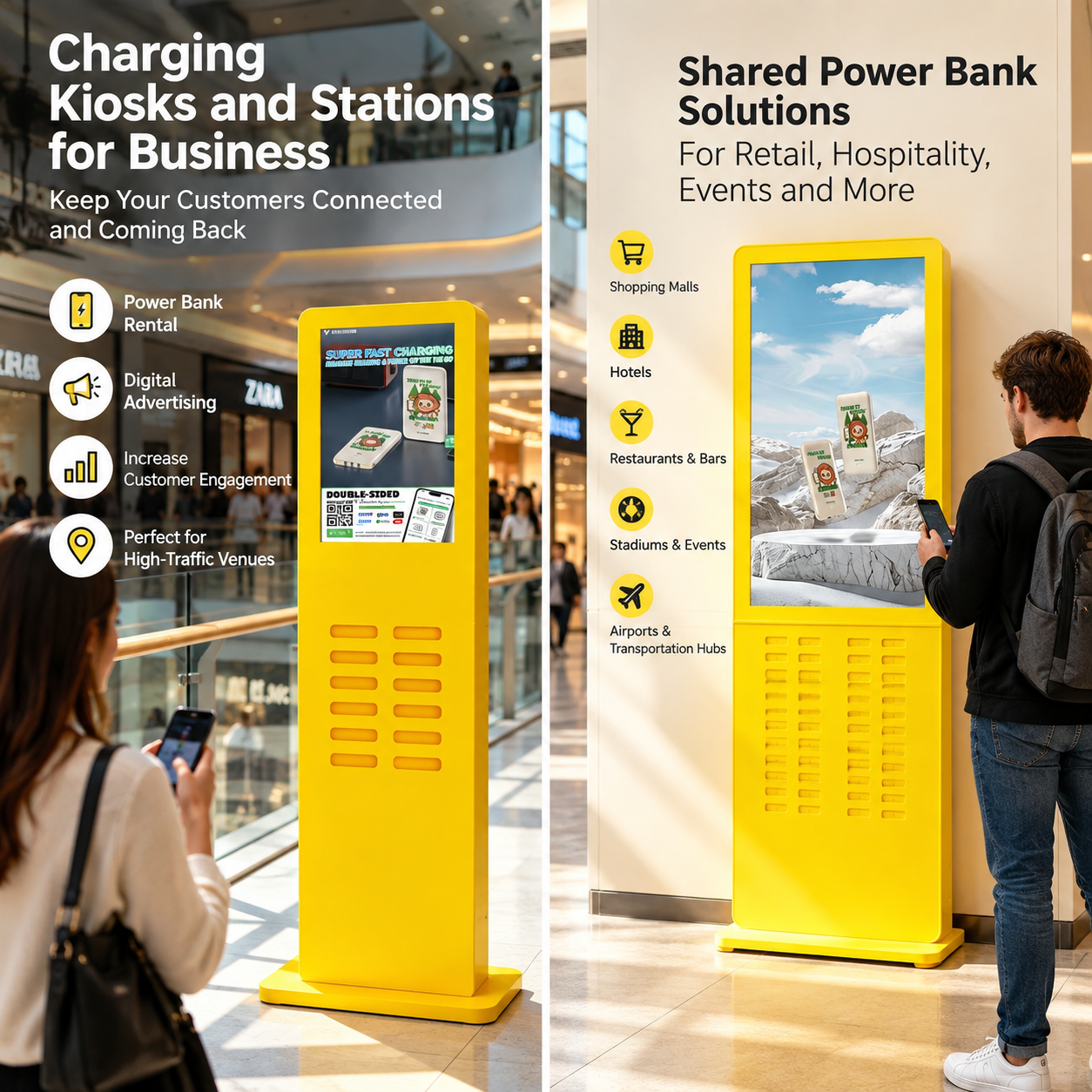
Charging Kiosks and Stations for Business: The Rise of the Shared Power Bank Economy
Smartphones have evolved from communication devices into essential tools for everyday life. Consumers now rely on their phones for payments, transportation, navigation, event tickets, social media, work, photography, food delivery and entertainment.
That dependence is creating a new challenge for businesses and public venues: keeping customers connected when their batteries begin to run low.
As mobile usage continues to grow worldwide, shared power bank rental networks and charging kiosks are emerging as a new category of urban infrastructure.
For restaurants, shopping centers, stadiums, hotels, entertainment venues and transportation hubs, mobile charging is increasingly becoming more than a convenience. It can also improve the customer experience, increase engagement and create new revenue opportunities.
Smartphone Use Continues to Expand Worldwide
The global smartphone ecosystem is still growing.
DataReportal reported that by April 2026, approximately 5.83 billion people worldwide were using mobile phones, representing more than 70% of the world’s population. The number of cellular connections associated with smartphones had reached roughly 7.64 billion, with smartphone connections increasing by around 3.1% over the previous year.
GSMA data also illustrates how important mobile connectivity has become to the global economy. Mobile technologies and services generated approximately $7.6 trillion in economic value in 2025, equivalent to 6.4% of global GDP.
But the significance of smartphones is not simply about how many devices are in circulation.As smartphone dependence continues to grow, Charging Kiosks and Stations for Business are becoming increasingly relevant for venues where customers spend long periods of time.
It is about what people now use those devices for.
A person visiting a shopping mall may use a smartphone to find a store, make a payment and communicate with friends. A traveler may rely on the same device for boarding passes, navigation and ride-hailing. At a concert or stadium, the phone may function simultaneously as a ticket, camera, wallet and social-media device.
As more everyday activities move onto smartphones, a depleted battery can become a much bigger problem than it was a decade ago.
The Growing Problem of Low-Battery Anxiety
The increasing dependence on smartphones has also created what researchers sometimes describe as low-battery anxiety.
A Counterpoint Research consumer study found that 72% of surveyed smartphone users in India began feeling anxious when their battery reached 20% or below. The research also found that 46% charged their smartphones twice a day, while half of respondents reported using a power bank.
More recent Counterpoint research published in 2026 again reported that 72% of surveyed Indian users felt anxious when their smartphone battery fell to 20% or less.
These studies relate specifically to the surveyed Indian market and should not automatically be treated as global percentages. However, they illustrate a broader commercial issue: consumers increasingly depend on constant access to their smartphones.
For venue operators, that creates an opportunity.
Instead of customers leaving a restaurant, shopping center, casino or event because they need to find a wall outlet, a shared power bank allows them to continue using their phone while moving freely around the venue.
Why Shared Power Banks Are Different From Traditional Charging
Traditional charging lockers and wall-mounted charging points solve one part of the problem, but they often require users to remain close to the charging location.
Shared power bank rental systems introduce mobility.
A customer can typically rent a portable battery from a station, continue shopping, dining, attending an event or traveling, and later return the power bank to a compatible station.
This changes charging from a static facility into a network-based service.
The model becomes particularly interesting when several stations operate across a city, entertainment district, airport, shopping center or national venue network.
Consumers are no longer simply looking for an electrical outlet.
They are accessing temporary energy through a distributed network.
Charging Kiosks Are Becoming Business Infrastructure
This shift is helping create what could be described as the shared power bank economy.
For businesses, the value of charging infrastructure is not limited to the rental fee itself.
Modern Charging Kiosks and Stations for Business can be deployed in stadiums, hotels, casinos, retail centers, transportation hubs, restaurants, bars and other high-traffic venues.
chargeFUZE, for example, positions its charging network around three primary benefits for venue operators: improving the guest experience, enabling scalable deployment and creating revenue or sponsorship opportunities.
That reflects a wider evolution taking place within the industry.
A charging station can potentially serve several purposes at the same time:
Utility: keeping visitors’ smartphones operational.
Customer experience: removing the inconvenience and anxiety associated with low battery levels.
Revenue: generating rental income or participating in venue revenue-sharing models.
Advertising: using integrated screens for brand advertising, promotions and sponsorships.
Engagement: creating another physical touchpoint between a venue and its customers.
This combination makes charging infrastructure increasingly relevant to businesses where customers spend significant periods of time.
Longer Visits Create More Opportunities
The economics become particularly interesting for hospitality and entertainment venues.
Imagine a customer attending a four-hour sporting event with 15% battery remaining.
Without charging access, that customer may reduce phone use, stop taking photos, avoid using mobile ordering or even leave an area to search for a charger.
Portable charging changes that experience.
Instead of leaving the venue or remaining beside a wall socket, the customer can rent a power bank and continue moving freely.
For restaurants, casinos, shopping malls, festivals and entertainment venues, keeping customers comfortable and connected may also help support longer engagement with the location.
chargeFUZE cites this kind of venue experience as part of its business model, with charging installations designed for high-traffic environments where visitors depend heavily on their phones.
For venue operators, Charging Kiosks and Stations for Business provide a practical way to address low-battery anxiety without forcing customers to remain beside a wall outlet.
From Charging Service to Advertising Platform
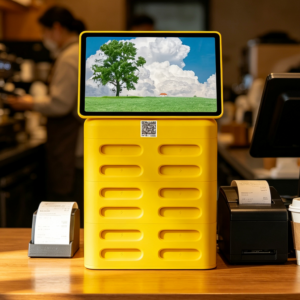
Another important development is the integration of digital displays into large charging kiosks.
Once a charging cabinet includes a large commercial screen, the economics of the equipment change.
The station is no longer only:
It can become:
Charging + Digital Signage + Advertising + Sponsorship
A charging kiosk positioned inside a stadium, airport, casino or shopping center can attract attention precisely because customers already have a reason to approach it.
Brands can use the display for advertising, while venues can promote events, food and beverage offers, memberships or sponsor campaigns.
This creates the possibility of multiple revenue streams from a single piece of physical infrastructure.
For large venue networks, digital advertising may ultimately become as important as charging revenue itself.
Why High-Traffic Locations Matter
Not every location generates the same level of demand.
Shared power bank economics tend to become more attractive in locations where three conditions overlap:
High foot traffic, longer dwell times and frequent smartphone usage.
That is why charging kiosks are increasingly appearing in places such as stadiums, arenas, shopping malls, casinos, hotels, airports, train stations, restaurants, nightlife venues, tourist destinations, conferences and festivals.
In these environments, users are away from home for long periods while simultaneously using smartphones more intensively.
Navigation, video recording, social media, digital payments and mobile tickets all consume battery power.
The result is a predictable charging problem—and a business opportunity for whoever solves it conveniently.
The Next Stage of the Shared Power Bank Economy
Shared power banks are unlikely to replace home or office charging. That is not their purpose.
Their value is providing electricity at the moment and location where users unexpectedly need it.
That distinction is important.
Ride-hailing did not replace private transportation. Food delivery did not replace restaurants. Shared power banks do not replace personal chargers.
Instead, these services monetize convenience.
As smartphones become even more integrated into payments, AI services, transportation, entertainment and digital identity, remaining connected becomes increasingly important.
With billions of smartphones already active worldwide and mobile usage continuing to expand, businesses may increasingly treat charging availability in the same way they once treated Wi-Fi: initially an optional amenity, but eventually an expected part of the customer experience.
That creates a growing opportunity for charging kiosk operators, venue owners, distributors and shared power bank networks.
The next phase of the industry may therefore be about much more than batteries.
It may be about building a distributed network that combines energy, mobility, digital advertising and physical retail engagement into a single infrastructure layer.As mobile dependence continues to increase, Charging Kiosks and Stations for Business may become an increasingly common part of modern customer-service infrastructure.