

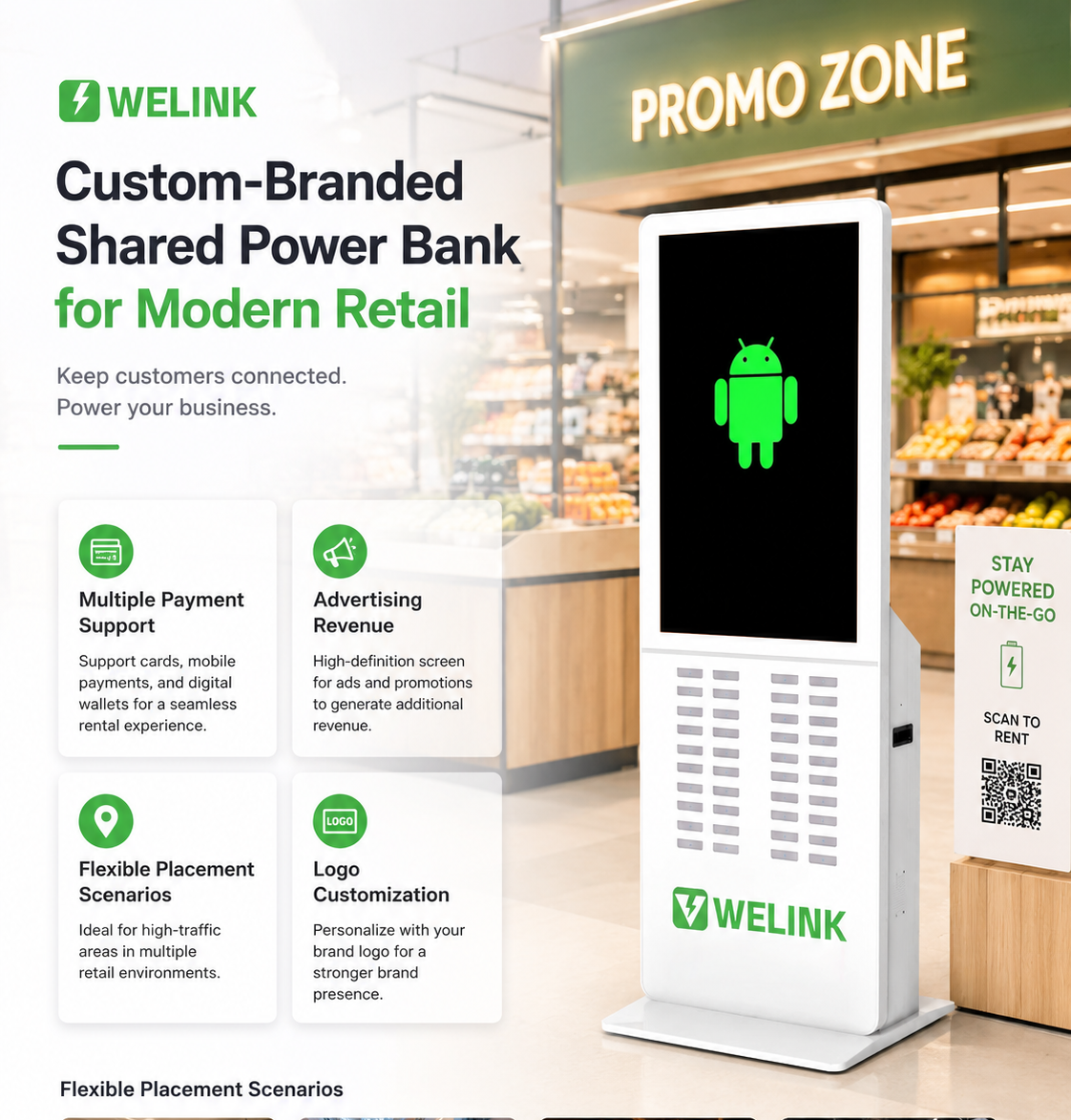
Shared Power Bank Business: 7 Revenue Opportunities for Smarter Retail Growth
A Shared Power Bank Business is no longer only a convenience service for people whose phones are running out of battery. In high-traffic locations, it can become a compact commercial platform that combines charging, digital advertising, flexible payment, brand exposure, and recurring rental income. For shopping malls, supermarkets, restaurants, airports, hotels, exhibitions, entertainment venues, and transport hubs, the same station can serve customers while creating new opportunities for operators and venue partners.
WELINK helps businesses turn this model into a practical, scalable solution. From shared power bank hardware and branded stations to payment integration, advertising screens, management software, deployment planning, and operational support, our goal is to make the Shared Power Bank Business easier to launch, manage, and expand.
Table of Contents
Why the market opportunity is growing
Advertising revenue beyond charging fees
Flexible payment for better conversion
Scalable profit and network growth
Brand marketing and commercial visibility
Flexible deployment across multiple scenarios
Why choose WELINK
A practical path to launch
1. Why a Shared Power Bank Business Creates More Than Rental Income
The strongest advantage of a Shared Power Bank Business is that one physical station can support several commercial functions at the same time. A customer sees the station, rents a portable charger, interacts with the screen or QR code, makes a payment, and continues shopping while staying connected.
This makes the Shared Power Bank Business especially attractive in environments where foot traffic, dwell time, and mobile phone usage are already high. Instead of relying on one revenue source, operators can design a model that combines rental fees, advertising packages, merchant cooperation, brand sponsorship, and location partnerships.
2. Advertising Revenue: Turn the Station Into a Digital Media Asset
Advertising is one of the most important growth opportunities in a Shared Power Bank Business. Large-screen charging stations can do more than display rental instructions. They can become digital advertising terminals positioned inside valuable commercial locations.
Supermarkets can promote weekly offers; malls can feature tenant campaigns; restaurants can highlight menus; airports and events can sell screen exposure directly to sponsors, travel brands, and retailers.
This creates a second layer of monetization. Rental revenue depends on how many customers borrow a power bank, while advertising revenue can be generated from screen exposure, campaign duration, location value, or commercial sponsorship. A well-positioned Shared Power Bank Business can therefore earn from both service usage and media inventory.
3. Flexible Payment Makes the Shared Power Bank Business Easier to Use
A Shared Power Bank Business should remove friction from the rental process. Customers may come from different countries, use different banks, or prefer different mobile payment methods. The easier it is to pay, the more likely a customer is to complete a rental.
Depending on the project and local payment environment, a WELINK solution can be designed to work with multiple payment channels, such as bank cards, mobile wallets, QR payments, or local payment gateways. The exact integration depends on the customer’s market, merchant account, and payment provider.
A flexible payment architecture also supports the future growth of the Shared Power Bank Business. As the operator enters new cities or countries, payment methods can be reviewed and adapted to local user habits instead of forcing every market into one payment model.
For general information about modern digital payment infrastructure, businesses can also review <a href=”https://stripe.com/payments“>Stripe’s payments overview</a> as an external industry resource.
4. Scalable Profit: From One Location to a Commercial Network
The real growth potential of a Shared Power Bank Business appears when successful locations are repeated. One station may serve one supermarket, but a network can cover an entire supermarket chain, shopping district, restaurant group, airport, university, or city.
As deployment expands, the operator gains more rental points, more advertising screens, more customer touchpoints, and more data for evaluating location performance. This network effect can create several commercial layers: rental income, advertising revenue, merchant partnerships, franchise or agent models, and customized brand projects.
The Shared Power Bank Business is also measurable. Operators can review rental frequency, station availability, returned units, location performance, payment success, and revenue trends through the management platform. These insights help identify which sites deserve additional units and which sites require adjustment.
When these foundations are in place, adding new stations becomes an extension of the same system rather than a completely new project.
5. Brand Marketing Turns Utility Into Commercial Visibility
A Shared Power Bank Business can be a brand marketing channel as well as an energy service. The cabinet, power banks, screen interface, QR code page, rental page, and advertising content can all carry a consistent brand identity.
WELINK supports customization options for projects that want their own commercial identity. Depending on the selected hardware and project scope, branding can include cabinet logos, power bank logos, brand colors, screen graphics, startup content, promotional materials, and customized user-facing interfaces.
This is especially useful for telecom companies, payment companies, retail groups, shopping centers, hospitality brands, event organizers, and entrepreneurs building their own shared charging brand.
Instead of placing a generic device in a store, operators can create a recognizable branded service. Every rental becomes another brand interaction. Every station becomes a physical media point. Every advertising screen becomes a commercial communication channel.
6. Multiple Placement Scenarios Increase Commercial Opportunity
A successful Shared Power Bank Business should not depend on a single type of venue. Shared charging is relevant anywhere people spend time and rely heavily on their phones.
Suitable scenarios can include supermarkets, shopping malls, restaurants, cafés, bars, hotels, airports, railway stations, exhibition centers, hospitals, universities, tourist attractions, entertainment venues, office buildings, gyms, and convenience stores.
Each location has a different commercial advantage. Supermarkets offer regular daily traffic. Shopping malls provide long dwell time and advertising value. Restaurants and cafés create natural waiting periods. Airports and transport hubs serve travelers who depend on phones for tickets, maps, payments, and communication.
7. WELINK Provides an Integrated Shared Power Bank Business Solution
Launching a Shared Power Bank Business requires more than buying charging stations. Hardware must work with software. Software must communicate with payment systems. Payments must match the rental logic. Devices must be monitored. Merchants must be managed. Customers need a simple rental and return process. Branding must remain consistent across the network.
WELINK provides an integrated approach designed around these practical requirements.
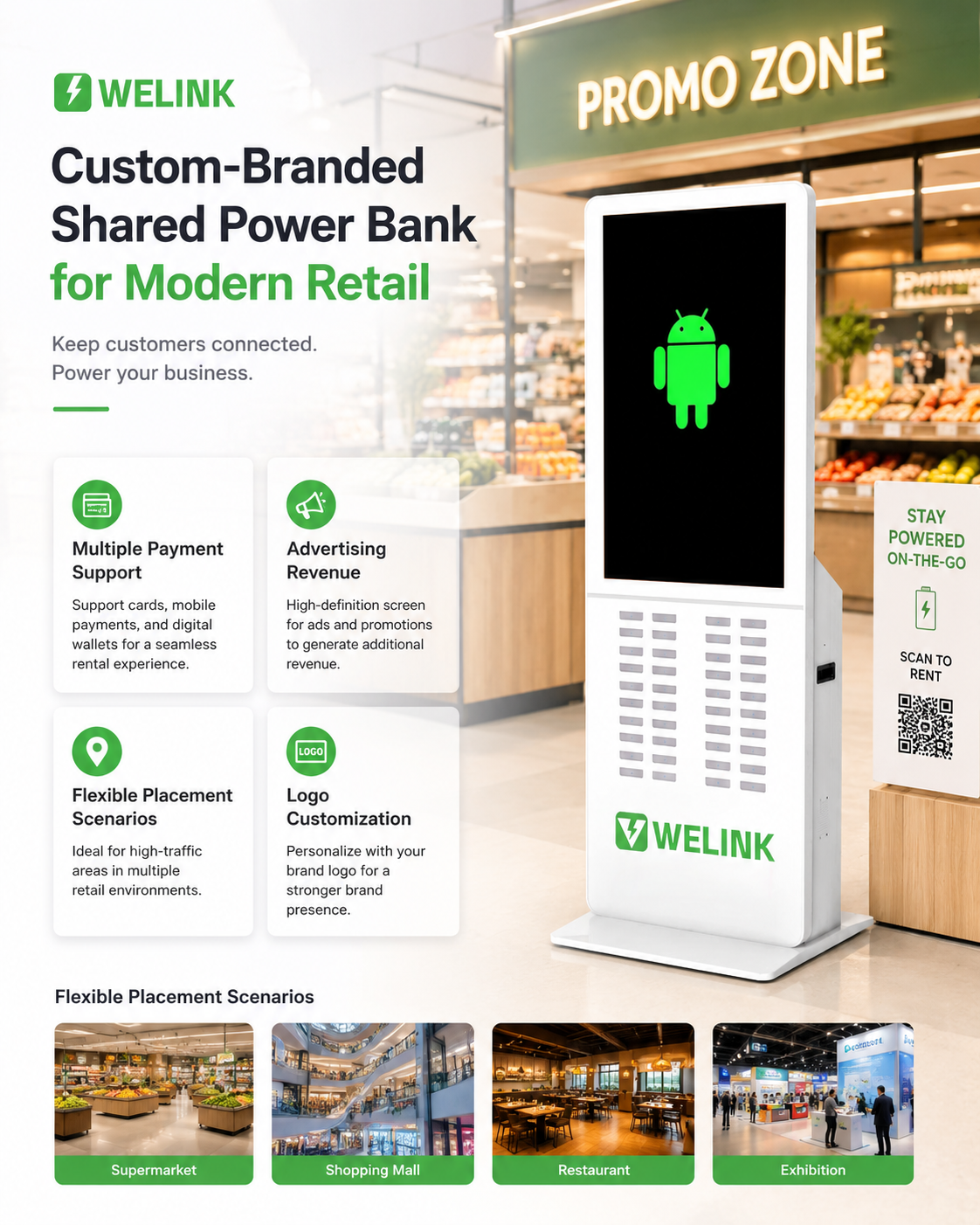
Our solution can cover shared power banks, charging stations, large-screen advertising terminals, customized branding, system integration, payment connection support, backend management, QR-based rental workflows, advertising display capability, and project deployment assistance.
For customers building their own brand, we can discuss OEM and customization requirements. For operators entering a new market, we can help define the hardware configuration, user journey, payment requirements, pricing logic, station deployment, and operating workflow.
The objective is straightforward: reduce the number of disconnected suppliers and give the customer a clearer path from concept to commercial operation.
Explore WELINK shared power bank solutions to learn more about available station formats and customization options.
8. Build a Shared Power Bank Business Around Service, Media, and Growth
The best Shared Power Bank Business models are not built around charging alone. They combine a real consumer need with strong commercial visibility and flexible monetization.
Charging creates the reason for the customer to interact with the station. Flexible payment reduces barriers to rental. Advertising creates an additional revenue channel. Custom branding turns equipment into a marketing asset. Multi-scenario deployment creates network coverage. Management software gives operators the information needed to scale with greater control.
For retailers and venue owners, the Shared Power Bank Business can improve customer convenience while opening additional partnership and media opportunities. For entrepreneurs and network operators, it can create a repeatable service model that grows by adding locations, users, advertisers, and commercial partners.
WELINK can support the Shared Power Bank Business from hardware selection to branding, payment integration, software configuration, advertising display, deployment, and operational planning. Whether you are starting with a pilot project or preparing a multi-city rollout, we work with you to understand the business model first and configure the solution around real operating requirements.
If you want to launch your own Shared Power Bank Business, the next step is to define your target country, placement scenarios, expected station quantity, payment methods, pricing model, branding requirements, advertising strategy, and expansion plan. With those inputs, WELINK can help you build a more complete one-stop solution for your market.