

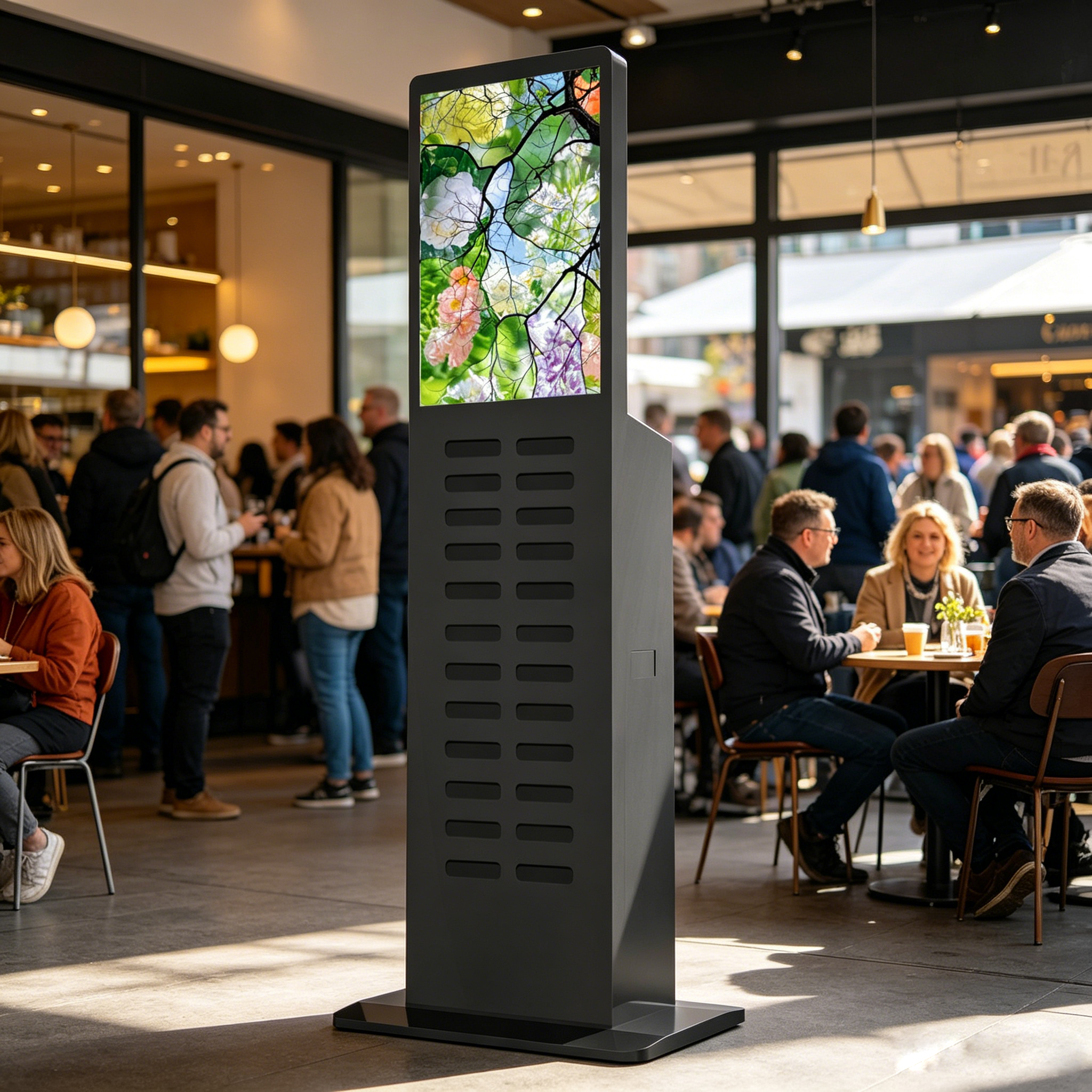
Should You Invest in Overseas Shared power bank? ROI & Market Risks 2026
The shared power bank rental business has become one of the fastest-growing smart charging solutions worldwide. Following the success of markets such as China, Southeast Asia and Europe, many entrepreneurs are exploring whether launching a power bank rental business in their own countries can generate sustainable returns in 2026.
However, unlike China, overseas markets require a different strategy. Successful operators need to carefully select high-value locations, control hardware investment costs, and choose reliable shared power bank manufacturers with complete hardware and software solutions.
This article will analyze the investment cost, revenue model, ROI calculation, and key risks of starting a shared power bank rental business overseas.
I. Shared Power Bank Business Investment Cost in 2026
We adopt a 8-slot shared power bank rental station for accurate payback period estimation: purchasing 100 sets of 8-slot shared power bank rental stations at a unit cost of USD 150 per set.
Total equipment cost: 100 × 150 = USD 15,000
Deploy the 100 sets of devices in high-matching scenarios including bars, sports venues, concert halls, specialty restaurants and scenic spots, with a baseline rental price set at USD 1 per hour.
We adopt a highly conservative usage assumption: each station is rented by only one user for one hour per day, generating USD 1 daily revenue per device.
- Total daily revenue for 100 stations: 1 × 100 = USD 100
- Monthly revenue: 100 × 30 = USD 3,000
- Revenue for 5 months: 3,000 × 5 = USD 15,000
The calculation clearly shows that under conservative operating conditions, the full hardware investment can be recovered within just 5 months. In real operational scenarios, most high-traffic locations record higher rental frequency and longer single usage duration than the hypothetical baseline, which will further shorten the payback cycle and lift profit efficiency.
This projection may sound appealing, but investment decisions cannot rely solely on idealized financial estimates. Four core variables must be fully evaluated for smooth project rollout and sustainable profitability, so as to mitigate operational risks.
II. Four Core Variables Affecting Profitability & Payback Period
1. Tiered Rental Pricing: Differentiated Pricing Based on Local Conditions
Consumption power varies drastically between cities, and even between different venues within the same city, so a uniform pricing strategy for shared power banks is not feasible. This logic can be illustrated by the pricing of bottled mineral water: prices differ greatly between ordinary convenience stores and high-end entertainment venues.
Therefore, scenario-based differentiated pricing is recommended for shared power banks. For high-value traffic locations with urgent charging demand and strong willingness to pay, such as airports, high-speed railway stations, convention and exhibition centers, bars and nightclubs, core scenic areas, large shopping malls, premium hotels, stadiums and concert venues, the hourly rental rate can be set above USD 1 to boost single-device revenue.
2. Device Rental Frequency: Precise Selection of High-Demand Scenarios
Unlike China’s high population density and full-scenario blanket deployment model, most overseas countries have low population density, making large-scale indiscriminate equipment rollout impractical. The core overseas operation strategy is targeted, concentrated deployment focusing on rigid-demand scenarios.
Prioritize venues with dense foot traffic, long customer dwell time and vibrant nighttime consumption, such as bars, sports arenas and concert sites. At these venues, customers heavily rely on mobile phones for entertainment, photography and social interaction, leading to severe battery anxiety and strong rental demand. Precise placement in these high-potential spots will easily push device utilization and rental frequency far above our conservative calculation, driving steady revenue growth.
3. Merchant Cooperation & Revenue Sharing Models: Flexible Partnership Options
Placing equipment at premium locations requires cooperation with venue owners, and certain partnership terms will involve entry fees or revenue splits, which directly extend the payback timeline. Three mainstream cooperation models are widely adopted in overseas markets, selectable based on venue footfall and consumption level:
- a. Agency Model: Merchants purchase devices to become regional agents and receive revenue shares at an agreed ratio.
- b. Free Placement with Revenue Sharing: The investor provides devices free of charge and takes charge of full operation and maintenance, while splitting rental revenue with venue merchants by a fixed percentage.
- c. One-Time Entry Fee Buyout Model: The investor supplies devices for free and pays a lump-sum entry fee upfront to the merchant, with no further revenue sharing required for subsequent operating income.
Additionally, shared power banks effectively resolve customers’ low-battery pain points and prevent early departures caused by dead phones, helping merchants improve customer retention and on-site consumption. For this reason, most venue owners welcome the installation of charging stations, resulting in relatively accessible cooperation thresholds.
4. Software System Costs: Amortize Upfront Expenses Through Scale Deployment
A supporting intelligent management SaaS system is a mandatory upfront investment for launching the shared power bank project, covering core functions including backend device management, order settlement, data statistics and user operation. This fixed cost will moderately lengthen the basic payback cycle.
However, the software expense can be effectively amortized by scaling up equipment quantity: the more stations deployed, the lower the allocated software cost per unit. Investors can select corresponding system versions according to investment scale and development stage to control initial capital expenditure.
III. Profit Advantages & Diversified Revenue Streams of Overseas Projects
Overall, the shared power bank rental business remains a blue-chip niche market with low competition, robust demand and high profit potential globally in 2026. Young overseas consumers frequently travel cross-border and engage in abundant offline entertainment activities. Meanwhile, free public charging sockets are extremely limited across Europe and America. Local users suffer from severe battery anxiety due to heavy daily phone usage, and their willingness to pay for charging services far exceeds that of domestic consumers in China, forming solid market demand.
By strictly controlling the four key factors of pricing, scenario selection, merchant cooperation and cost control, and adopting refined concentrated small-batch deployment, the overall payback period for overseas projects stabilizes at 6–10 months with reliable profitability.
Furthermore, overseas shared power bank rental have evolved beyond single rental income, with multiple additional revenue channels expanding total profit margins:
- Advertising Revenue: The built-in LCD screen on charging stations can display ads for local brands and offline stores to generate continuous advertising income.
- Deposit Working Capital Revenue: User rental deposits can be used as circulating funds for daily operation to improve capital turnover efficiency.
- Short-Term Equipment Leasing Revenue: Provide temporary device rental services for concerts, exhibitions, outdoor sports events and other activities to capture incremental earnings.
IV. Three Critical Pre-Launch Criteria for Overseas Rollout (City Suitability Assessment)
Beyond the above profit-related variables, three fundamental factors determine whether a city is suitable for shared power bank rental business, governing compliant, stable and long-term business operation:
1. Maturity of Local Payment Infrastructure
Verify whether the region has well-established third-party online payment and credit card payment systems to ensure seamless QR-code rental and automatic settlement. Inadequate payment channels will hinder user transactions and cause order losses.
2. Compliance Qualification of Equipment Manufacturers
Only partner with legitimate original manufacturers to guarantee hardware compliance with local market access standards, especially strict GDPR requirements for personal data storage and user privacy protection, so as to avoid regulatory and policy risks.
3. Operational Stability of Devices
Prioritize highly stable, low-failure-rate equipment to drastically cut later maintenance, repair and replacement costs. Longer service life of charging stations equals an extended profitable operation cycle and higher overall return on investment.
V.Choose a Reliable Shared Power Bank Manufacturer
Choosing the right manufacturing partner is critical for long-term success. A professional shared power bank manufacturer should provide:
✓ Hardware production
✓ White-label customization
✓ Mobile APP solution
✓ Backend management system
✓ Payment integration
✓ Remote monitoring
✓ Technical support
VSCHARGE is a professional shared power bank manufacturer in China, providing complete OEM/ODM solutions for global operators.