

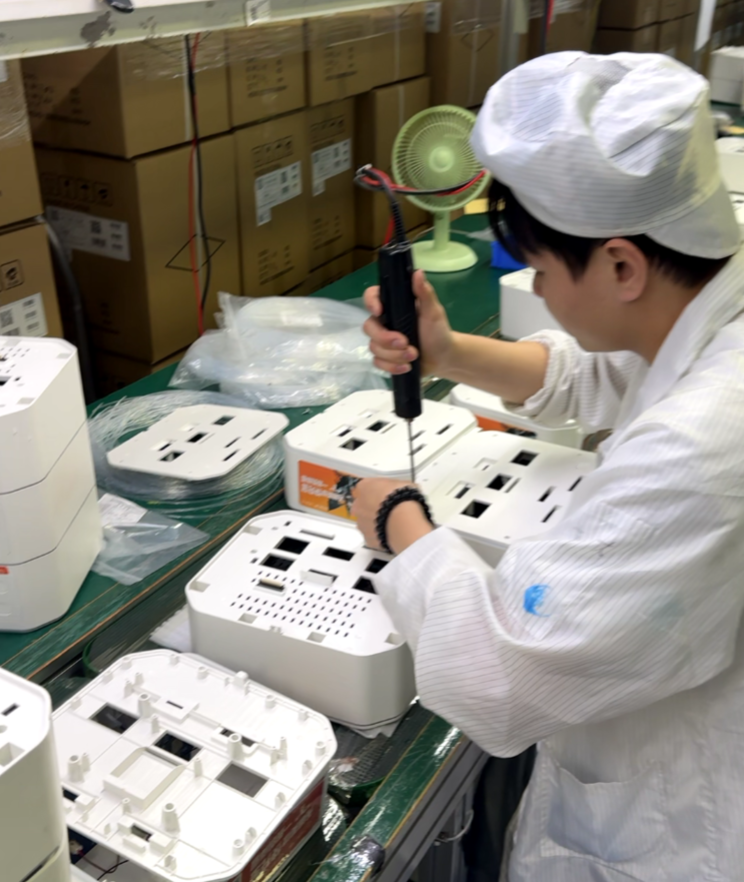
A Shared Power Bank Factory is much more than a facility that assembles charging products. For entrepreneurs, distributors, charging network operators, telecom companies, retailers, and established brands, the manufacturer behind the product can directly influence quality, delivery speed, branding, operating stability, and future business growth.
WELINK provides an integrated manufacturing process from concept to shipment. As a professional Shared Power Bank Factory, we combine product design, R&D, mold development, PCB engineering, SMT production, printing, assembly, testing, packaging, customization, and production planning.
Our goal is not simply to manufacture machines. We help customers create products that are ready to become part of a scalable commercial brand.
Table of Contents
-
-
- Why Manufacturing Capability Matters
- Product Design and Business Planning
-
R&D and Engineering
-
-
- Mold and Tooling Development
- SMT and PCB Manufacturing
- Printing and Brand Customization
- Assembly and Quality Control
- Efficient Mass Production
- WELINK Brand Launch Planning
- Why Choosing a Reliable Manufacturer Matters
-
1. Why a Shared Power Bank Factory Matters
Shared charging equipment operates differently from ordinary consumer electronics.
A station installed in a shopping mall, supermarket, restaurant, airport, hotel, or railway station may operate continuously while handling repeated rental, return, charging, communication, and payment-related processes.
For this reason, the quality of a Shared Power Bank Factory can directly affect the operator’s daily business.
If hardware failure rates are high, operators may face more maintenance visits, unavailable rental slots, customer complaints, and interrupted revenue.
Reliable manufacturing creates a stronger foundation for commercial operation.
WELINK focuses on building products around both manufacturing requirements and real shared charging scenarios.
2. From Product Idea to Industrial Design
Every project starts with an idea.
Customers may require a compact desktop station, a larger cabinet for supermarkets, or a floor-standing advertising station for high-traffic locations.
Before manufacturing begins, the Shared Power Bank Factory needs to understand the complete requirement.
This can include:
-
-
-
-
-
-
-
-
-
-
- Number of charging slots
- Cabinet dimensions
- Power bank capacity
- Charging connectors
- Screen size
- Advertising requirements
- Network configuration
- QR code position
- Logo customization
- Product colors
- Target market
- Expected order quantity
-
-
-
-
-
-
-
-
-
WELINK works with customers to transform these commercial requirements into practical product specifications.
Industrial designers then consider appearance, materials, internal structure, user interaction, maintenance access, ventilation, branding areas, and manufacturing efficiency.
A successful design must look professional while also being suitable for stable mass production.
3. R&D Is the Foundation of a Reliable Shared Power Bank Factory
Behind every charging station is a combination of electronics, mechanical structures, firmware, communication modules, battery management, and software interaction.
This makes R&D a critical part of a Shared Power Bank Factory.
WELINK engineers can work on PCB design, charging logic, slot control, battery management, communication, firmware, power distribution, and hardware integration.
Before mass production, prototypes can be tested and adjusted.
Engineers may optimize PCB layouts, component selection, structural tolerances, heat management, charging performance, communication stability, and user interaction.
Finding problems during development is significantly more efficient than discovering them after thousands of units have already entered the market.
4. Mold Development and Tooling
Once the structure is confirmed, the project can move into tooling.
For customized products, mold development may include power bank shells, cabinet components, slot structures, buttons, internal supports, and other plastic or structural parts.
A professional Shared Power Bank Factory should carefully control mold accuracy because tooling affects dimensions, surface quality, assembly consistency, and long-term repeat production.
The general process can include:
3D Design → Engineering Review → Mold Design → Tooling → Trial Production → Measurement → Modification → Sample Approval
After trial samples are produced, dimensions and assembly fit should be checked before the mold enters full production.
Accurate tooling can improve efficiency while reducing future assembly problems.
5. SMT and PCB Production
SMT—surface-mount technology—is another important manufacturing stage.
Electronic components are automatically placed onto printed circuit boards and soldered through controlled production processes.
The PCB is responsible for many important functions inside a shared charging station.
These can include power management, charging control, communication, slot detection, locks, device status reporting, and interaction with other system components.
For this reason, a reliable Shared Power Bank Factory should pay close attention to component quality, placement accuracy, soldering, PCB inspection, and functional testing.
WELINK coordinates electronic production according to the approved project specification.
Testing boards before final assembly can help identify problems earlier and reduce unnecessary rework.
6. Printing and Brand Customization
For many customers, manufacturing is also the beginning of brand commercialization.
A Shared Power Bank Factory should therefore be able to support more than standard hardware.
WELINK can provide customization options depending on the product and order requirements, including:
-
-
- Customized cabinet colors
- Customer Logo
- Power bank Logo printing
- UV printing
- Silk-screen printing
- Cabinet graphics
- QR code design
- Screen advertising content
- Customized packaging
- Branded user-facing materials
-
The printing stage should control logo position, size, clarity, color consistency, adhesion, and overall appearance.
When the charging station, power bank, software interface, advertising display, and packaging use the same visual identity, customers can create a more professional and recognizable commercial brand.
This is one of the major advantages of working directly with a capable Shared Power Bank Factory instead of purchasing generic products from multiple suppliers.
7. Assembly and Quality Control
Once shells, PCBs, cables, displays, power modules, printed components, and other materials are ready, the project enters final assembly.
At the Shared Power Bank Factory, standardized production procedures help keep every unit consistent.
Depending on the product configuration, manufacturing checks may include:
1.Power-on testing
2.Power bank charging
3.Slot detection
4.Lock and release testing
5.Network communication
6.Screen operation
7.QR code inspection
8.Firmware verification
9.Charging performance
1.Appearance inspection
Finished equipment can also undergo repeated rental and return simulations, aging tests, charging tests, and final packaging inspections according to project requirements.
Quality control is particularly important for shared charging because equipment is usually deployed across many different locations.
Preventing a problem inside the factory is much more efficient than repairing the same problem across hundreds of commercial sites.
8. Production Efficiency Supports Faster Expansion
When an order grows from 20 machines to 200, 2,000, or more, manufacturing efficiency becomes increasingly important.
A professional Shared Power Bank Factory needs to coordinate raw materials, electronic components, plastic parts, printing, SMT capacity, assembly lines, testing, packaging, and delivery schedules.
WELINK focuses on creating repeatable manufacturing processes.
Once a model and specification are approved, future production can follow the established standard rather than restarting product development for every order.
This can help customers move more smoothly from sample orders to pilot projects and then toward larger deployment.
Production efficiency can also influence commercial growth.
Manufacturing efficiency does not automatically guarantee profitability, but stable quality, controlled lead times, and repeatable supply can help operators spend less time solving hardware problems and more time developing profitable locations.
9. From One Product to an Entire Brand
WELINK believes a Shared Power Bank Factory should help customers think beyond the first shipment.
Many successful shared charging businesses begin with a limited pilot.
After proving the business model, operators may expand into:
-
-
- Shopping malls
- Supermarkets
- Restaurants
- Cafés
- Hotels
- Airports
- Railway stations
- Hospitals
- Universities
- Entertainment venues
- Exhibition centers
-
Different environments may require different station formats.
Large floor-standing stations with advertising screens can serve high-traffic commercial locations, while compact desktop stations may be more suitable for restaurants and individual stores.
A capable Shared Power Bank Factory can help customers maintain the same brand identity across these different products.
10. WELINK Creates Your Brand Manufacturing Plan
Instead of simply asking, “How many units do you want?”, WELINK looks at the complete project.
We can discuss the target country, business model, deployment locations, cabinet type, power bank specifications, branding, payment requirements, advertising requirements, launch quantity, and future expansion plan.
From there, our Shared Power Bank Factory can help create a more structured production roadmap.
A typical process may look like this:
Business Requirement
↓
Product Selection
↓
Industrial Design
↓
Engineering & R&D
↓
Prototype
↓
Mold Development
↓
PCB & SMT Production
↓
Printing & Branding
↓
Assembly
↓
Functional Testing
↓
Quality Inspection
↓
Packaging
↓
Mass Production
↓
Shipment
↓
Market Launch
This integrated process helps reduce communication gaps between separate suppliers.
11. A Reliable Shared Power Bank Factory Can Support Profit Growth
For shared charging operators, profit growth usually depends on much more than the purchase price of hardware.
Revenue can be influenced by rental frequency, location quality, advertising income, payment conversion, equipment uptime, maintenance costs, and network size.
A reliable Shared Power Bank Factory supports this business by providing more stable hardware and repeatable supply.
When equipment operates consistently, operators can focus on expanding profitable locations, developing merchant partnerships, selling advertising space, and building customer awareness.
As the network grows, additional equipment can create more rental points and more advertising inventory.
This means manufacturing scalability becomes part of commercial scalability.
12. Why Choosing a Reliable Manufacturer Is So Important
The cheapest supplier is not necessarily the most economical supplier over the full life of a project.
Poor-quality electronics, unstable firmware, inaccurate molds, weak printing, inconsistent assembly, or delayed deliveries can create significant costs after deployment.
Before selecting a Shared Power Bank Factory, customers should consider:
-
-
- R&D capability
- Manufacturing experience
- Quality control
- Product customization
- Production capacity
- Engineering support
- Communication efficiency
- Repeat-order consistency
- After-sales coordination
- Ability to support future expansion
-
A reliable manufacturer should be able to understand both the product and the commercial application behind it.
For general information about quality management principles used by manufacturing organizations worldwide, you can also review the ISO 9001 Quality Management overview.
You can also explore our WELINK shared power bank solutions to learn more about available station formats, customization, and project possibilities.
13. One Factory, One Process, One Business Direction
Managing multiple suppliers for industrial design, molds, PCBs, printing, assembly, software-compatible hardware, packaging, and final production can make a project unnecessarily complicated.
An integrated Shared Power Bank Factory can simplify communication and make responsibilities clearer.
WELINK combines these production stages into one coordinated manufacturing workflow.
For customers entering the shared charging industry, this means there is a clearer path from an initial idea to a commercially deployable product.
For established operators, it provides a manufacturing foundation for larger repeat orders and new branded product lines.
Conclusion: Build Your Shared Charging Brand With WELINK
Choosing the right Shared Power Bank Factory is not simply a purchasing decision. It is a decision about product quality, operational reliability, brand presentation, production efficiency, and future scalability.
WELINK integrates design, research and development, mold development, SMT, printing, assembly, testing, customization, packaging, mass production, and project support into one manufacturing process.
Our objective is to help customers move from idea → product → production → brand → market.
Whether you are developing your first shared power bank project or preparing to expand an existing network, WELINK can work with you to create a manufacturing and brand launch plan based on your business requirements.
A professional Shared Power Bank Factory gives you more than machines.
It gives your business a reliable manufacturing foundation.
And when product quality, brand consistency, production efficiency, and scalable supply work together, that foundation can support stronger and more sustainable commercial growth.