

Scaling Shared Power Bank Brands in Saudi Arabia: Custom OEM & ODM Manufacturing Strategies
Executive Key Takeaways
To achieve large-scale commercialization of shared power bank services in Saudi Arabia, operators must implement a multi-dimensional development system centered on localized customized manufacturing and regional channel cooperation. In-depth research into Saudi consumer habits, religious customs and consumption logic serves as the fundamental premise for differentiated product design. Stable strategic alliances with local retail merchants, entertainment venues and tourism operators can significantly expand terminal coverage and optimize distribution efficiency. Data-based user behavior analysis enables precise marketing operations and continuously lifts user stickiness and brand loyalty. Continuous collection and iteration of end-user feedback helps products and operation systems adapt to rapidly evolving market demands. Prioritizing localized cultural adaptation creates unique competitive barriers for brands, securing long-term sustainable development within Saudi Arabia’s shared charging track.
1 Market Overview: Development Landscape of Shared Power Banks in Saudi Arabia
1.1 Core Market Quantitative Index Table
Saudi Arabia’s rapid digital transformation and booming domestic tourism have spawned surging demand for outdoor portable charging equipment. However, most imported standard shared power bank products fail to adapt to local high-temperature climate, religious aesthetic standards and exclusive payment ecosystems, leading to low user conversion rates. Customized ODM/OEM manufacturing targeting Saudi local demand has become the core breakthrough for brand scale-up. Welink Energy’s localized customized production system has accumulated verified landing experience for regional market operators.
1.2 Core Restrictions of Standard Generic Equipment in Saudi Market
Climate incompatibility: Long-term high temperature environment (up to 50℃ in summer) leads to accelerated battery attenuation of ordinary equipment;
Cultural mismatch: Conventional appearance patterns and screen content do not conform to local aesthetic and regulatory norms;
Payment barrier: Generic systems lack native docking with Saudi mainstream Mada payment gateway;
Operation defects: General background systems lack Arabic multilingual modules and local data compliance architecture.
2 Customized Manufacturing: Core Competitive Advantages for Saudi Market
Customized hardware and software development is the core support for brands to gain market share in Saudi Arabia. Welink Energy’s full-set localized customization system solves the four major pain points of standard equipment mentioned above.
2.1 Five Major Localized Customization Features & Matching Value Table
2.2 Customized Production Industrial Logic
Relying on automated mass production lines, manufacturers can realize small-batch trial production without high MOQ restrictions: samples delivered within 3 working days, mass production completed within 25–45 working days. Customized molds, circuit optimization and system secondary development can be completed in one-stop, avoiding multi-supplier coordination costs for operators. Customized products form differentiated barriers in the homogeneous Saudi market, effectively lifting terminal rental conversion rate by over 30%.
3 Boosting Market Presence via Localized Marketing & Operations
3.1 Targeted Brand Promotion Paths
Local KOL & Retail Channel Co-branding: Cooperate with well-known local lifestyle influencers and chain merchants to improve regional brand credibility;
Offline Scene Sponsorship: Layout charging terminals in large-scale tourism, entertainment and commercial events to increase exposure;
Social Media Precision Operation: Deliver localized content on mainstream Saudi social platforms to release equipment usage benefits and venue cooperation cases.
3.2 Data-Driven User Operation Mechanism
The white-label background system independently developed by Welink supports full-dimensional statistics of rental volume, user portraits and revenue data. Operators can formulate differentiated pricing and promotion strategies based on scenario passenger flow data, effectively lifting user repeat rental rate and long-term brand loyalty. Real-time user feedback collection function supports rapid iterative optimization of equipment and operation rules.
4 Local Partner Ecosystem Construction
Stable cooperation with local merchants, distributors and after-sales service providers is an indispensable foundation for large-scale brand expansion in Saudi Arabia.
4.1 Value of Local Strategic Partners Table
Partnership alliances realize resource sharing: local partners provide offline scene resources and market insight, while manufacturers supply customized equipment, complete compliance certificates and remote technical support. Brands such as Tipacharge have realized nationwide coverage of terminals through deep local distribution cooperation, with partner retention rate exceeding 85%.
5 User Experience Optimization System
User satisfaction directly determines venue renewal rate and repeat rental volume. All customized equipment for the Saudi market adopts experience-oriented optimization design:
Simplified rental process: Complete the whole borrowing and returning process within 3 steps via screen or mobile terminal;
Multi-port compatible power banks: Support simultaneous charging of multiple electronic devices;
24/7 remote technical support: 70% software failures can be repaired remotely within 5 minutes via the cloud platform;
Complete after-sales mechanism: German Hamburg overseas warehouse stores spare parts, with delivery time to Saudi Arabia within 3 working days, matching 1–2 years global warranty policy.
6 Differentiated Custom Design Solutions
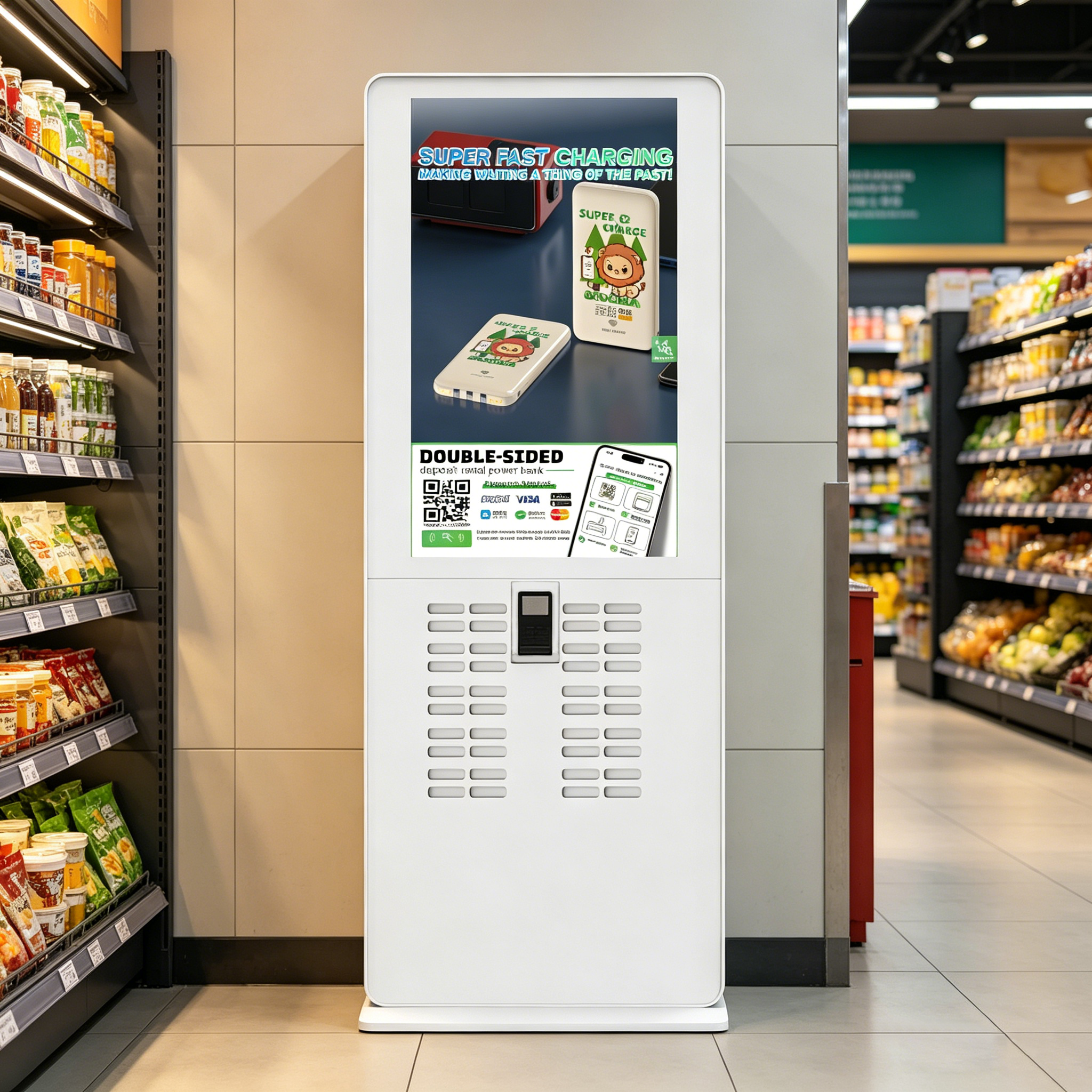
Product differentiation design is the core means to avoid homogeneous competition in Saudi shared charging track. All appearance, hardware function and system modules can be independently customized according to brand positioning and scene characteristics. A09 large screen advertising machine can display localized commercial promotion content, bringing stable additional advertising income for venue partners. The equipment’s high-temperature resistant structural design solves the core pain point of equipment failure caused by Saudi extreme summer weather, significantly reducing long-term operation and maintenance costs.
7 Comprehensive Winning Strategies for Saudi Shared Power Bank Market
Demand Orientation: Take Saudi climate, culture and payment habits as the bottom line for all customized product development;
Custom Manufacturing: Adopt full ODM/OEM one-stop service to build exclusive brand differentiated products;
Local Alliance: Establish multi-level cooperation network covering retail, distribution and after-sales;
Data Operation: Rely on cloud background big data to realize precise marketing and user retention;
Iterative Upgrade: Continuously optimize equipment and operation logic based on user and partner feedback.
Enterprises implementing the above five-dimensional composite strategy can effectively reduce market entry risks, shorten brand incubation cycle and realize sustainable scale expansion in Saudi Arabia’s fast-growing shared charging market.
8 Conclusion
The Saudi shared power track maintains a high growth trend driven by digital transformation and domestic tourism boom. Successful brand scale-up relies on a composite development system integrating localized customized manufacturing, regional channel cooperation, data-based refined operation and user experience iteration. Manufacturers represented by Welink Energy provide full-set hardware, software and compliance customization solutions matching Saudi market characteristics, helping brands break through the pain points of generic equipment incompatibility. Deep integration of localized culture, payment ecology and scene demand can build irreplaceable brand competitive advantages, thus capturing long-term stable dividends in the blue ocean market of Saudi shared portable charging.
Industry Standard FAQs
Q1 What is a shared public charging device?
A: Shared power bank terminals are commercial rental portable power supply equipment for public scenes, which allow users to rent portable lithium power banks to charge mobile electronic devices on demand.
Q2 What is the standard rental process for shared power banks in Saudi Arabia? A: Users operate Arabic/English dual-language terminal screens, select rental packages, complete payment through local payment channels such as Mada or credit cards, and take out power banks; they can return equipment at any network terminal after use for automatic settlement.
Q3 How to handle equipment malfunctions during rental?
A: Users can contact online customer service through the rental mini-program or APP; operators receive early warning via the AI cloud monitoring system. Software faults can be remotely repaired instantly, while damaged hardware can be replaced with spare parts shipped from Hamburg overseas warehouse within 3 days.
Q4 Are there any service fees for shared power bank rental?
A: Rental charges are calculated by usage duration, with differentiated pricing standards for malls, restaurants and tourist attractions; advertising viewing services on large-screen terminals are free for users.
Q5 Can one power bank charge multiple electronic devices simultaneously?
A: All customized models for Saudi market are equipped with multi-output interfaces, supporting simultaneous charging of multiple mobile phones and wearable devices.
Q6 What special regulatory requirements should be noted for using charging equipment in Saudi Arabia?
A: Equipment must pass CE, UN38.3 and other Middle East mandatory certification standards; screen display, shell patterns and text content need to comply with local cultural and publicity regulatory provisions.
Q7 What payment methods are supported for rental in Saudi Arabia?
A: The customized system natively docks Mada local bank cards, Apple Pay, Google Pay and international credit cards, covering over 90% of mainstream payment tools used by local residents and foreign tourists.