

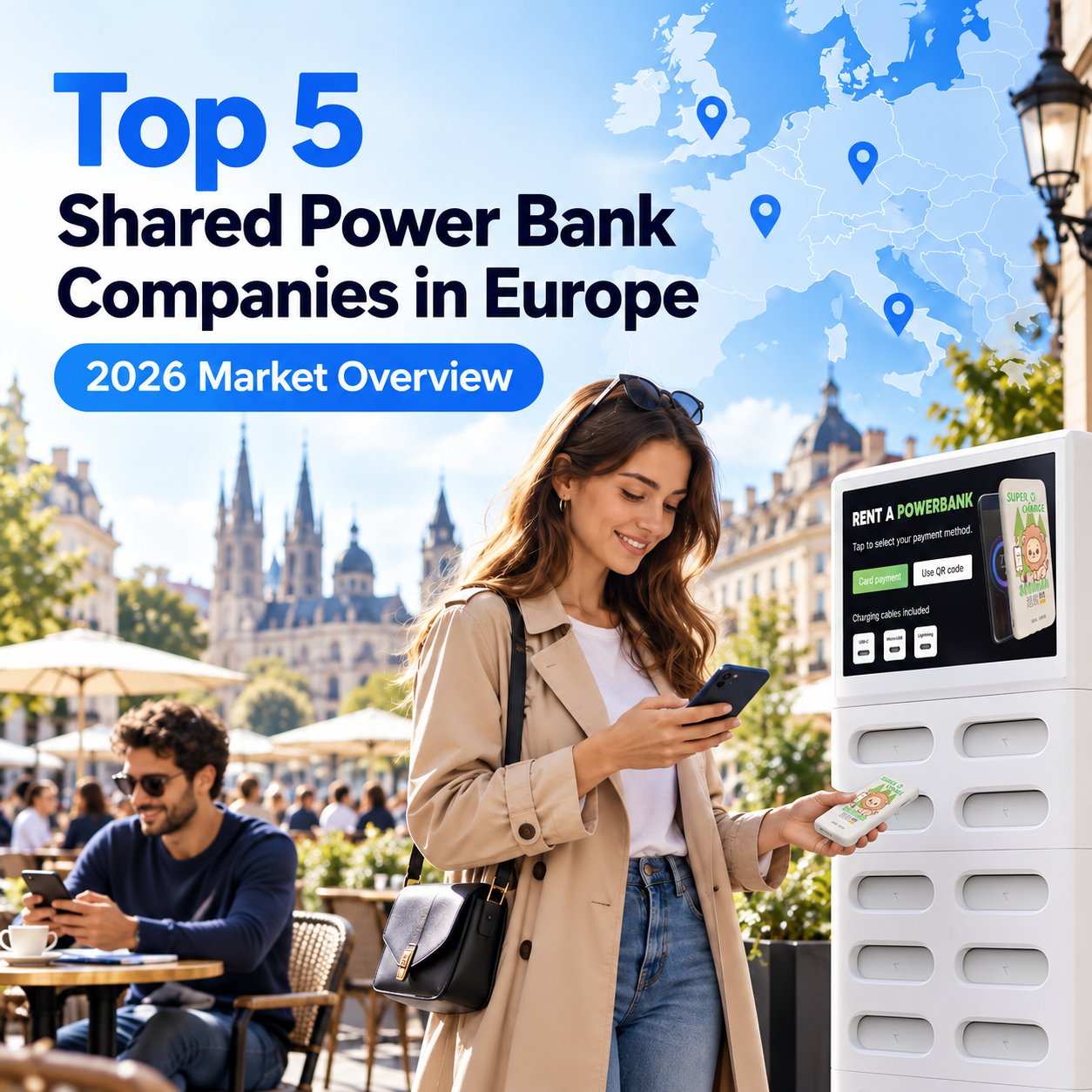
Top 5 Shared Power Bank Companies in Europe: Market Leaders & Trends in 2026
The shared power bank industry is gaining increasing attention across Europe as smartphones become essential to everyday life. From restaurants and shopping malls to music festivals, airports, and entertainment venues, portable charging services are creating new opportunities for businesses and consumers.
As demand for convenient mobile charging grows, shared power bank rental stations are becoming an increasingly attractive business solution.
Unlike traditional charging points, shared power bank systems allow customers to rent a portable battery, charge their phones while moving, and return the battery to a compatible station within the same network.
Several companies have established recognizable shared charging services across European markets.
In this article, we explore five notable shared power bank companies in Europe in 2026, examine their business models, and discuss the opportunities for entrepreneurs interested in launching their own power bank rental businesses.
Editor’s note: This is an editorial selection of five established or emerging European operators, not an independently audited ranking by revenue, station count, or market share.
1. Brick – Shared Power Bank Network from Sweden
Country of Origin: Sweden
Website: https://www.brick.tech
Business Model: Power bank rental network and franchise partnerships
Brick is one of the most recognizable companies in the European shared power bank industry.
Founded in Stockholm in 2019, Brick has developed a network of portable charging stations serving hospitality businesses, entertainment venues, transportation locations, and public spaces.
According to its published company information, Brick operates across more than 25 countries, with approximately 4,000 participating venues.
Key Features of Brick
Brick offers a variety of shared power bank solutions designed for different commercial environments.
Its product portfolio includes compact countertop stations, touchscreen rental stations, and larger advertising-enabled charging kiosks.
Users can rent portable chargers through supported digital rental methods, including browser-based rentals and contactless payment options on compatible stations.
The company also provides management solutions for operating and monitoring charging networks.
Brick’s Business Strategy
Brick combines its charging network with venue partnerships and franchise opportunities.
Restaurants, cafés, hotels, and entertainment businesses can benefit from offering portable charging services to visitors.
Meanwhile, entrepreneurs can explore franchise arrangements to develop local rental networks.
Why Brick Matters
Brick demonstrates how a shared power bank business can expand through strategic partnerships with local venue operators rather than relying exclusively on company-owned locations.
2. Naki – Shared Power Bank Rental Network Across Europe
Main Markets: Multiple European countries
Website: https://www.naki.app
Business Model: Shared portable charging network
Naki is another notable player in Europe’s shared power bank rental industry.
The company focuses on providing accessible portable charging solutions for consumers who need additional smartphone battery power while traveling, shopping, dining, or attending events.
According to its official website, Naki has established more than 2,000 charging stations across Europe.
Its network includes locations in Belgium, France, Spain, Sweden, and other markets.
Key Features of Naki
One of Naki’s strengths is its convenient rental process.
Customers can use a web-based rental experience by scanning a QR code, avoiding a mandatory app download.
Naki also provides mobile applications for customers who prefer additional account and rental management features.
Another important feature is cross-station returns within its supported network.
Customers can rent a power bank at one participating location and return it to another compatible Naki station.
Naki’s Business Strategy
Naki focuses on making portable charging available across frequently visited public and commercial locations.
Its business model highlights the importance of network accessibility and a convenient user experience.
Why Naki Matters
Naki illustrates how QR-code rentals, browser-based payment experiences, and cross-location returns can support the growth of shared charging services.
For new operators, reducing unnecessary steps during the rental process can be an important consideration.
3. ChargedUp – A Major UK Power Bank Rental Network
Country of Origin: United Kingdom
Website: https://www.chargedup.green
Business Model: Shared power bank rental and venue partnerships
ChargedUp is an established shared charging operator in the United Kingdom.
Founded in London in 2017, the company has developed a portable charging network focused on hospitality and entertainment locations.
Its charging stations are designed for venues such as pubs, bars, restaurants, hotels, and event spaces.
Key Features of ChargedUp
ChargedUp emphasizes a simple rental experience.
Customers can use supported contactless payment methods to unlock a portable charger without downloading an application.
After renting a power bank, users can continue charging their phones while moving around.
The power bank can then be returned to another participating ChargedUp station.
ChargedUp’s Business Strategy
ChargedUp works closely with hospitality businesses.
Its venue partnership model allows participating businesses to provide a convenient charging service without necessarily becoming independent charging network operators.
The company also promotes revenue-sharing opportunities for venue partners.
Why ChargedUp Matters
ChargedUp demonstrates the potential of shared charging services in nightlife and hospitality environments.
For bars, restaurants, and entertainment venues, convenient smartphone charging can improve the customer experience.
The company’s contactless rental approach also highlights the growing importance of frictionless payment methods in the European market.
4. UpCharge – Shared Power Bank Solutions from Finland
Country of Origin: Finland
Website: https://www.upcharge.eu
Business Model: Portable charging rental and franchise partnerships
UpCharge is a Finnish shared power bank company that provides portable charging services through a network of rental stations.
The company focuses on making mobile charging accessible in commercial and public locations.
Its services are associated with markets including Finland and other European countries.
Key Features of UpCharge
UpCharge provides portable power banks that customers can rent when their smartphones need additional battery power.
The service uses charging stations placed in participating venues.
Customers can locate rental stations, borrow a portable charger, and return it to a compatible location within the supported network.
The company also offers digital rental functionality and business partnership opportunities.
UpCharge’s Business Strategy
UpCharge combines a portable charging service with local partnerships and franchise development.
This approach allows the company to work with businesses interested in introducing shared charging services to their local markets.
Why UpCharge Matters
UpCharge represents an example of how smaller European operators can develop regional charging networks.
Its model also demonstrates that the shared power bank industry is not limited to large European capitals.
Smaller cities, local commercial centers, and regional partnerships can also present opportunities for charging services.
5. Mr. Charge – An Emerging Shared Power Bank Operator in Romania
Country of Origin: Romania
Website: https://mrcharge.eu
Business Model: Power bank rental stations, venue partnerships, and franchise opportunities
Mr. Charge is a Romanian shared power bank rental company focused on convenient mobile charging solutions.
The service was launched in December 2022 and has pursued expansion through partnerships with businesses and commercial venues.
Mr. Charge provides shared portable charging services designed for people who need to recharge their smartphones while away from home.
Key Features of Mr. Charge
Mr. Charge operates power bank rental stations that allow customers to access portable charging devices at participating locations.
Its business model focuses on convenience, accessibility, and charging services in areas with regular customer traffic.
The company’s franchise offering includes branded charging stations and supporting promotional equipment.
Mr. Charge targets a range of commercial environments, including:
1:Restaurants, cafés, and hospitality venues
2:Shopping malls and retail locations
3:Fitness centers and gyms
4:Entertainment and event locations
5:Healthcare and other public-facing facilities
Mr. Charge and the Demand for Fast Mobile Charging
As consumers increasingly use smartphones for navigation, payments, social media, and communication, convenient charging has become more important.
Fast charging is also becoming a relevant consideration for portable charging solutions.
For companies operating shared charging networks, charging performance can influence customer satisfaction, although actual charging speed depends on the power bank, smartphone, charging protocol, and cable compatibility.
Operators evaluating new equipment should therefore examine supported charging standards and measured output rather than relying only on marketing descriptions such as “fast charger.”
Mr. Charge’s Business Strategy
Mr. Charge uses a partnership-oriented business model.
The company seeks to expand its presence by working with venue owners and local business partners.
Its franchise model creates opportunities for entrepreneurs interested in developing portable charging services in their own markets.
Why Mr. Charge Matters
Mr. Charge is an example of the growing diversity of the European power bank sharing industry.
While larger networks receive considerable attention, regional operators are also exploring opportunities in underserved locations and developing markets.
For entrepreneurs, companies such as Mr. Charge demonstrate how a recognizable local brand and commercial partnerships can support the development of a charging network.
Comparison: Five Shared Power Bank Companies in Europe
The following table summarizes the positioning of the five companies discussed in this article.
| Company | Primary Market or Origin | Business Focus | Key Characteristics |
|---|---|---|---|
| Brick | Sweden | Charging network and franchising | International network, venue partnerships, multiple station formats |
| Naki | Europe | Portable charging rental | QR-code rentals, web app, cross-station returns |
| ChargedUp | United Kingdom | Hospitality charging network | Contactless rentals, venue partnerships, revenue sharing |
| UpCharge | Finland | Regional charging networks | Portable charging, local partnerships, franchising |
| Mr. Charge | Romania | Charging stations and franchise opportunities | Branded stations, venue partnerships, regional expansion |
These companies operate under different commercial models, making direct comparisons based on network size or market share difficult.
However, they share one important objective: making portable charging more accessible to consumers.
Why Is the Shared Power Bank Business Growing in Europe?
Europe offers several attractive conditions for shared power bank rental businesses.
1. Increasing Smartphone Dependence
Smartphones have become essential tools for communication, digital payments, transportation, navigation, entertainment, and everyday business activities.
When a phone battery runs low, users may need an immediate charging solution.
Portable charging rental services address this demand without requiring consumers to carry their own power banks.
2. Opportunities in High-Traffic Locations
Shared charging stations can be installed in locations where people spend considerable time.
Examples include restaurants, shopping malls, airports, train stations, universities, hotels, sports venues, and music festivals.
These locations can provide access to customers who may require temporary charging services.
3. Growth of Contactless Payment Technology
European consumers are familiar with digital payment methods, including bank cards, Apple Pay, and Google Pay.
For shared power bank operators, integrating convenient payment methods can reduce friction during the rental process.
Depending on the equipment and software solution, customers may be able to rent a portable charger using QR codes, mobile browsers, or contactless card terminals.
4. Flexible Business Models
A shared power bank network can operate under several business models.
Some companies manage their own stations and collect rental revenue directly.
Others cooperate with venue owners through revenue-sharing agreements.
Franchise arrangements also allow regional operators to build charging networks using established brands and technology.
Businesses can select an operating structure based on their target market, available resources, and long-term strategy.
5. Opportunities for Local Branding
Not every entrepreneur wants to operate under an existing charging network.
Some businesses prefer to establish their own brand, manage customer relationships independently, and control their rental revenue.
This creates demand for white-label shared power bank rental systems and customizable charging hardware.
How to Start a Shared Power Bank Rental Business in Europe
For entrepreneurs interested in entering the European shared charging market, selecting the right equipment and software infrastructure is an important first step.
A successful rental network requires more than simply purchasing charging stations.
Operators should evaluate several essential components.
Choosing the Right Shared Power Bank Stations
Charging stations are available in different configurations.
Compact countertop models are suitable for cafés, restaurants, bars, and smaller retail locations.
Larger stations with digital displays may be more appropriate for shopping malls, entertainment venues, and advertising-focused business models.
Common configurations include 8-slot, 12-slot, and larger-capacity charging stations.
Selecting Suitable Portable Power Banks
Power bank capacity, charging speed, built-in cables, and durability can influence user experience.
For example, portable chargers equipped with USB-C and Lightning cables can serve a broad range of modern smartphones.
Fast charging capabilities may also improve convenience when supported by the connected device.
Payment Integration
Payment infrastructure is particularly important for shared power bank businesses operating across European countries.
Operators should consider support for payment providers such as Stripe and compatible payment terminals.
Depending on the integration, payments may support credit cards, debit cards, Apple Pay, and Google Pay.
Transaction fees, refunds, deposits, and payment authorization requirements should be evaluated before launching a network.
Rental Management Software
A shared charging business requires software capable of managing rental operations.
Important features may include:
1:QR-code power bank rentals
2:Rental pricing management
3:Power bank release and return monitoring
4:Cross-station returns
5:Payment gateway integration
6:Station status monitoring
7:Operator management dashboards
8:Rental transaction records
9:Revenue and performance reporting
A reliable management system helps operators control their network as it expands.
VSCHARGE: Shared Power Bank Manufacturer for European Business Operators
While Brick, Naki, ChargedUp, UpCharge, and Mr. Charge demonstrate different approaches to operating rental networks, entrepreneurs may also choose to develop their own independent charging brand.
VSCHARGE, powered by Shenzhen Welink Energy Co., Ltd., provides shared power bank rental hardware and software solutions for international business operators.
Rather than requiring customers to join an existing consumer rental network, VSCHARGE focuses on helping businesses build their own branded charging systems.
Factory-Direct Shared Power Bank Stations
VSCHARGE provides a range of shared power bank rental equipment, including compact stations and larger advertising display models.
The company’s solutions are designed for different commercial applications, including hospitality, retail, entertainment, and transportation environments.
OEM and ODM Customization
For companies developing their own shared charging brands, VSCHARGE offers OEM and ODM customization options.
These can include custom logos, product colors, power bank branding, and station appearance.
White-Label Rental Software
VSCHARGE also provides independently deployed white-label software solutions.
Businesses can operate under their own branding and manage rental services through a dedicated management platform.
Depending on the selected solution, customers can access rentals through an H5 mobile web interface or branded mobile applications.
API and Payment Integration
For businesses with their own development teams, VSCHARGE provides device communication protocol documentation and technical integration support.
This allows operators to explore connecting compatible charging stations with independently developed rental platforms.
Payment integration can also be customized according to the requirements of the target market and the technical capabilities of the selected payment provider.
Independent Business Operations
One important consideration for entrepreneurs is maintaining control over their rental operations.
VSCHARGE’s independently deployed software model allows operators to manage their own charging network, customer relationships, and rental transactions.
The company does not require a percentage of rental revenue as a platform commission.
Third-party payment processing fees and applicable infrastructure costs remain separate.
Learn more about VSCHARGE shared power bank solutions:
https://www.vscharge.com
Future Trends in Europe’s Shared Power Bank Industry
Looking ahead, several developments could influence the European portable charging market.
Contactless Rental Experiences
Simplified rental processes may become increasingly important.
Customers often prefer charging solutions that avoid complicated registration procedures or unnecessary application downloads.
QR-code web rentals and supported contactless payment terminals can help operators create more convenient experiences.
Faster Portable Charging Technology
As smartphones support higher charging speeds, demand for more capable shared power banks may increase.
Operators will need to balance charging performance with battery capacity, device compatibility, equipment cost, and product safety.
Advertising-Enabled Charging Stations
Charging stations equipped with digital screens can offer additional opportunities for commercial advertising.
These systems may allow operators to display promotional videos, brand messages, and venue-specific campaigns.
Advertising capabilities can provide another potential revenue stream alongside power bank rental fees.
Independent and White-Label Charging Networks
The European market includes both established charging brands and smaller regional operators.
Entrepreneurs may increasingly explore white-label hardware and software solutions that allow them to develop independent charging networks.
This approach can provide greater flexibility in branding, rental pricing, venue relationships, and business expansion.
Network Reliability and Customer Experience
As more companies enter the market, network quality will remain an important competitive factor.
Equipment reliability, convenient returns, transparent rental pricing, and accessible customer support can all influence customer satisfaction.
Frequently Asked Questions
Which are the top shared power bank companies in Europe?
Notable European shared power bank operators include Brick, Naki, ChargedUp, UpCharge, and Mr. Charge. These companies represent different markets and business models. There is no universally accepted public ranking of European operators by market share.
Is the shared power bank business profitable in Europe?
A shared power bank rental business can generate revenue through customer rentals, venue partnerships, and potentially advertising. However, profitability depends on station utilization, location quality, operating expenses, payment fees, and the cost of acquiring and maintaining equipment.
Can I start my own shared power bank company in Europe?
Yes. Entrepreneurs can establish independent shared charging networks using compatible rental stations, management software, and payment integration.
Do shared power bank stations require a mobile app?
Not necessarily. Some systems support QR-code rentals through a mobile browser, while others offer dedicated applications or contactless payment terminals.
Where can I find a shared power bank manufacturer?
Businesses looking to develop their own charging network can work with specialized shared power bank manufacturers such as VSCHARGE, which provides rental station hardware, white-label software, and OEM/ODM customization.
Conclusion
Europe’s shared power bank industry continues to attract operators with different business models and expansion strategies.
Companies such as Brick, Naki, ChargedUp, UpCharge, and Mr. Charge illustrate how portable charging networks can serve customers across hospitality, retail, transportation, and entertainment environments.
Although these operators differ in geographical coverage and commercial strategy, their services demonstrate the practical value of accessible mobile charging.
For entrepreneurs considering the shared power bank industry, the most important decisions involve choosing suitable locations, reliable equipment, convenient payment methods, and scalable rental management software.
Businesses that prefer to develop their own brands can explore factory-direct shared power bank solutions rather than joining an existing network.
Interested in starting your own shared power bank rental business in Europe?
Visit VSCHARGE to explore customizable shared power bank stations, OEM/ODM manufacturing, rental management software, and API integration solutions.
Website: https://www.vscharge.com
Disclaimer: Company information is based on publicly available sources reviewed in October 2026. Network coverage, services, and product offerings may change.