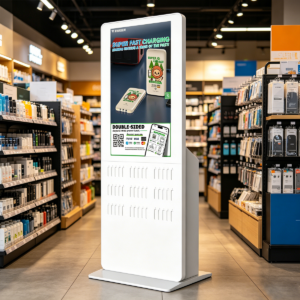
The shared power bank business is a rental service that allows customers to borrow portable chargers from automated stations and return them after use. It solves a common problem: running out of phone battery while away from home.
Shared power bank rental stations are commonly installed in restaurants, cafés, shopping malls, hotels, airports, hospitals, tourist attractions, transportation hubs, and entertainment venues.
Customers usually scan a QR code or use a supported payment method to rent a power bank. Operators generate revenue from rental fees, while partner merchants benefit from improved customer service, longer dwell times, and potential revenue sharing.
A complete shared power bank system normally involves three parties:
The rental process is straightforward:
The exact payment and return process can be customized according to the operator’s business model and local market requirements.
A shared power bank provides immediate access to portable charging when a customer forgets to bring a charger, has an uncharged personal power bank, or cannot find an available electrical outlet.
Modern rental power banks may support multiple connectors, such as USB-C, Lightning, and Micro-USB. Fast-charging models can also reduce the time required to restore a phone’s battery.
Power bank stations can be installed in places where customers spend significant time, including:
A well-planned station network gives customers convenient access to charging when and where they need it.
Customers do not need to purchase or carry a personal charger. They can rent a power bank through a QR code, mobile application, bank card, or contactless payment method, depending on the system configuration.
If cross-station returns are enabled, customers can borrow a power bank from one location and return it to another compatible station within the same network.
Offering portable charging helps merchants solve an immediate customer problem. Visitors with low phone batteries can continue using mobile payments, transportation applications, social media, and other essential services.
Customers may stay longer in a restaurant, café, bar, hotel, or entertainment venue when convenient charging is available. Longer visits may also create additional spending opportunities.
Depending on the cooperation agreement, merchants may receive a fixed placement fee or a percentage of rental revenue. The operator normally manages the equipment, software, payments, and technical maintenance.
Stations with digital displays can show venue promotions, product advertisements, event information, and branded content. Customized station cabinets and power banks can also strengthen the merchant’s brand visibility.
The main revenue source is power bank rental, but operators can develop several additional income channels.
Customers can be charged by the hour, by rental period, or according to a daily maximum rate. Operators can normally configure prices through the management platform.
Rates may vary according to:
Busy airports, tourist attractions, nightlife venues, and major events may support different pricing from restaurants or small retail stores.
Power bank stations with LCD or digital advertising screens can generate additional revenue. Operators may sell advertising space to local merchants, consumer brands, event organizers, and other commercial partners.
Operators can cooperate with merchants through a revenue-sharing model. This reduces the merchant’s initial commitment and gives both parties an incentive to promote the charging service.
Operators can provide customized power bank stations for:
Income may come from station rental, equipment sales, branding services, software configuration, or ongoing technical support.
Experienced operators may provide station management, maintenance, deployment analysis, and local support services to other businesses.
Operational data can be used internally to identify high-performing locations, improve inventory allocation, and optimize rental prices. Any collection or use of customer data must comply with applicable privacy and data-protection laws.
Launching a shared power bank business generally requires:
Stations are available in different capacities. Small 4-slot, 6-slot, or 8-slot models are suitable for cafés, restaurants, and retail stores. Larger 24-slot, 40-slot, or floor-standing stations are more suitable for airports, malls, hotels, tourist locations, and major events.
The business should not be evaluated based only on equipment prices. Operators should also consider:
A pilot deployment can help operators measure actual demand and operating costs before making a larger investment.
Location quality is one of the most important factors in the shared power bank business. A smaller network of carefully selected stations can perform better than a large number of machines placed without a clear strategy.
Good locations normally have:
Operators should monitor rental frequency, return rates, station availability, and revenue per location. Low-performing stations can then be moved to more suitable venues.
Profitability depends on equipment costs, rental prices, payment fees, merchant agreements, station utilization, and maintenance expenses.
The business can create recurring revenue because the same power bank can be rented many times. However, success is not automatic. Operators need reliable equipment, suitable locations, competitive pricing, local payment methods, and an effective maintenance plan.
Starting with a small pilot network is often the safest approach. Operators can collect real data, identify the best venue types, and expand after confirming local demand.
A reliable manufacturing partner should provide more than hardware. Look for a supplier that can offer:
Working with an experienced shared power bank manufacturer can reduce technical risks and shorten the time required to launch a local rental network.
VSCHARGE provides complete shared power bank rental solutions for international operators, distributors, and entrepreneurs.
Our services include rental stations, power banks, OEM and ODM branding, white-label software, cloud management platforms, payment integration, and technical support.
Whether you are planning a small market test or a large charging network, we can recommend suitable station models and software solutions based on your locations, payment requirements, and business plan.
Visit www.vscharge.com to learn more about launching your shared power bank business.